What If You're Solving the Wrong Problem?
Today, remember this.
It's surprisingly easy to spend a tremendous amount of time, money, and effort trying to solve the wrong problem.
Summer has a way of making a garden feel alive. Every morning, as I look out of my bedroom window, I see flowers opening, new leaves unfurling, and months of patient care and attention finally paying off.
Except for one small patch of raised flower bed, right outside my window.
For reasons I still don't fully understand, absolutely nothing seems to thrive there.
When I first moved in, there was a neat and tidy row of beautiful, tropical hibiscus planted there. Within weeks they were overrun with mealybugs, and soon, they were covered in this thick, cottony webbing. Despite my best efforts, they never recovered.
Next came a yucca. It didn't die, not exactly, but after months in the ground it still hadn't grown a single inch.
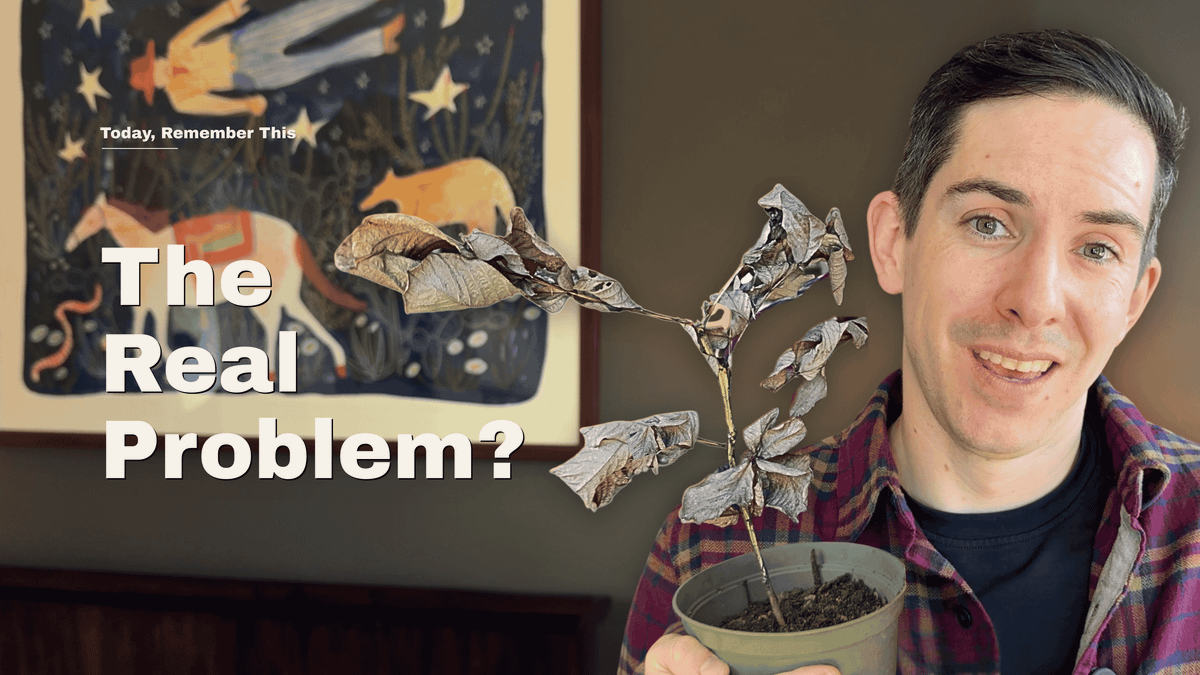
Finally, I tried a hearty shrub that the local plant nursery confidently assured me would "grow like a weed." They were half right. It certainly looked like a weed in my garden — but then quickly met a similar fate as the bed's prior tenants and was reduced to a leafless tumbleweed.
After each failure, I came to the same conclusion.
I must have picked the wrong plant.
Maybe the hibiscus was too delicate. Perhaps the yucca needed more sunlight. Maybe I simply hadn't found something tough enough for that particular spot.
But after enough disappointments, I began to wonder whether I'd been asking the wrong question all along.
What if the problem wasn't the plants?
What if it was the soil?
The truth is, I still don't know.
It could be compacted clay. Poor drainage. Something hidden beneath the surface, like a cracked sewage pipe seeping waste water into the surrounding earth — though I sincerely hope not...
Whatever the explanation, one thing seems increasingly obvious.
If the soil is the problem, then no amount of replacing healthy plants is ever going to solve it.
I've started wondering how often I do something similar elsewhere in life.
When a project stalls, my instinct is to double down and pile on more effort. I buy another productivity app. Read another how-to book. Devote more resources.
In other words, I keep attacking the thing I can see. But perhaps the real issue isn't the visible one. Perhaps it's hidden somewhere deeper — perhaps even literally, like the dirt in my flower bed.
Sometimes the hardest part of solving a problem isn't finding the right answer. It's making sure you've identified the right problem in the first place.
We often assume that more effort will eventually produce a better outcome. Sometimes it does. But effort applied to the wrong problem is remarkably expensive. It costs time, energy, attention, and often hope, while leaving the underlying issue untouched.
Sometimes the wisest thing we can do isn't to push harder. It's to pause. To step back. To ask a better question.
A question to take with you
When has changing your perspective on a problem been the key to unlocking a solution?